






A small international move does not require a full removal container; several specialist services exist specifically for smaller shipments, and choosing the right one depends on your volume, destination, timeline and the type of items you are taking.
Groupage sea freight (shared container) is the practical standard for most small household moves, while international box shipping suits the smallest volumes of personal effects with no furniture. PSS Removals provides groupage and small shipment international moving services across all major destinations, with a free pre-move assessment to confirm the right option for your specific circumstances.
This guide covers every available option so you can make an informed decision before you book anything.
Key Takeaways:
- Groupage (shared container) sea freight is the most cost-effective and practical option for most people moving abroad with only a few items, from a handful of boxes with furniture up to a one-bedroom household
- Air freight is faster but significantly more expensive; it is only practical for small, lightweight and urgent shipments where cost is secondary to speed
- International box shipping suits the smallest volumes; a few boxes or bags of personal effects with no furniture
- A full sole-use removal container is rarely necessary or cost-effective for a studio or one-bedroom relocation
- Customs requirements apply to all international shipments regardless of size; Transfer of Residence relief is available for qualifying small household moves
- A professional pre-move assessment confirms the most suitable service for your volume, destination and timeline; PSS offers this free of charge
What Are the Options for a Small International Move?

Planning a move abroad with minimal belongings raises an immediate practical question that most people find surprisingly difficult to answer: which service is actually right for a shipment that does not fill a full container? The options are more varied than most people realise, and choosing incorrectly typically means either overpaying or using a service that is not designed for what you are trying to ship.
Small International Move Options Compared
| Option | Best For | Typical Volume | Transit Time | Relative Cost |
| Groupage sea freight | Studio or 1-bed moves; partial household | 1 to 15 cubic metres | 3 to 16 weeks (destination dependent) | Medium |
| Sole-use container (20ft) | Larger 1-bed or small 2-bed moves | 15 to 28 cubic metres | Same as groupage; no consolidation delay | Medium to High |
| Air freight | Urgent, lightweight, small volume shipments | Under 100kg typically | 3 to 10 days | High |
| International box shipping | Smallest volumes: boxes, bags, personal items | Under 1 cubic metre | 1 to 6 weeks | Low to Medium |
| Excess baggage via airline | Clothing and personal items only | Under 30kg per item | Same as flight | Low |
| International courier | Single items or small parcels | Under 30kg | 3 to 10 days | Medium |
How to choose the right option:
- Volume is the primary decision driver; under ten boxes with no furniture suggests international box shipping; one to five cubic metres with some furniture points to groupage; above fifteen cubic metres warrants a sole-use container comparison
- Destination affects viability significantly; air freight to Australia or New Zealand is cost-prohibitive for anything beyond a few kilograms, and groupage sea freight is the practical standard for long-haul small moves
- Urgency matters; if the shipment must arrive within two to three weeks, sea freight groupage may not meet that timeline and air freight or an international courier should be considered
- Item type matters regardless of volume; fragile, high-value or regulated items require specialist handling that international courier or standard box shipping services may not provide
Contact PSS to discuss the right small move option for your destination
How to Ship a Small Load Overseas Without a Full Container
One of the most common assumptions people make when planning a small international move is that they will need to book a full container, and that everything below that threshold is either impractical or prohibitively expensive. Neither is true. Groupage sea freight exists specifically to solve this problem, and it is the standard service for small international household moves globally.
What is groupage sea freight?
Groupage (also known as LCL: Less than Container Load) is a sea freight service where multiple customers’ shipments are consolidated into a single shared container. Each customer pays only for the cubic metres their shipment occupies; the rest of the container space is filled by other customers’ shipments going to the same destination. The container is managed by the freight forwarder or removals company throughout transit; individual shipments are secured and separated within it. At the destination, the container is deconsolidated at a warehouse and each shipment is delivered separately to its final address.
For anyone planning this type of move with furniture involved, this is almost certainly the right service. It is cost-effective, professionally managed, and covers all the same customs, insurance and biosecurity compliance requirements as a full container shipment.
When groupage works best:
- Volumes between one and fifteen cubic metres; typically a studio flat, one-bedroom flat or a partial household
- Non-urgent shipments where a three to sixteen week transit window is acceptable depending on the destination
- Destinations served by established sea freight groupage lanes; this covers Europe, North America, Australia, New Zealand, Asia, the Middle East and South Africa
- Shipments containing furniture, household goods and personal effects that are correctly packed and documented
Groupage limitations to be aware of:
- Transit times are longer than sole-use containers because shipments wait at the UK depot for the container to reach consolidation before sailing; this adds two to four weeks compared to a dedicated container on the same route
- Items are handled more frequently than in a sole-use container, which makes correct packing particularly important for fragile pieces
- Some remote or less-served destinations may not have regular groupage sailings, which can extend total transit times further than the standard range
Get a groupage sea freight quote from PSS for your small international move
Cost-Effective Options for a Small International Household Move
Cost is the primary concern for most people shipping a small volume internationally, and understandably so. The good news is that smaller volumes genuinely are less expensive to ship than full households; the challenge is understanding what the total cost actually includes before comparing quotes.
Cost Drivers for Small International Moves
| Cost Element | Groupage Sea Freight | Air Freight | International Box Shipping |
| Base rate basis | Per cubic metre | Per kilogram | Per box or per kilogram |
| Minimum charge | Typically 1 cubic metre minimum | Typically 10kg minimum | Per box |
| Packing materials | Additional cost (or self-pack) | Included in some services | Often included |
| Customs clearance | Required; broker fee applies | Required; broker fee applies | Included in some services |
| Insurance | Separate marine cover; strongly recommended | Available; often included at basic level | Basic cover often included; check limits |
| Delivery to door | Included or quoted separately | Usually included | Usually door-to-door |
| Total relative cost for 2 cubic metres | Most cost-effective for this volume | Significantly higher | Comparable to groupage for very small volumes |
How to reduce the total cost of moving abroad with a small shipment:
- Be precise about volume; every cubic metre removed from the shipment reduces the groupage cost proportionally, so a realistic pre-move edit of what you are taking has a direct financial impact
- Sell, donate or store items that do not justify international shipping relative to their replacement value abroad; this is particularly relevant for low-value flat-pack furniture and worn household items
- Self-pack lower-risk items (clothing, books, kitchenware) to reduce packing service costs; use PSS professional packing for furniture and fragile items where insurance validity and biosecurity compliance require it
- Consolidate everything into boxes before the volume assessment; loose, unboxed items occupy significantly more space than the same items boxed efficiently
- Book well in advance of your move date; last-minute bookings limit groupage options and may push the shipment to the next available sailing, adding weeks to the timeline
Is Air Freight or Sea Freight Better for a Small International Move?
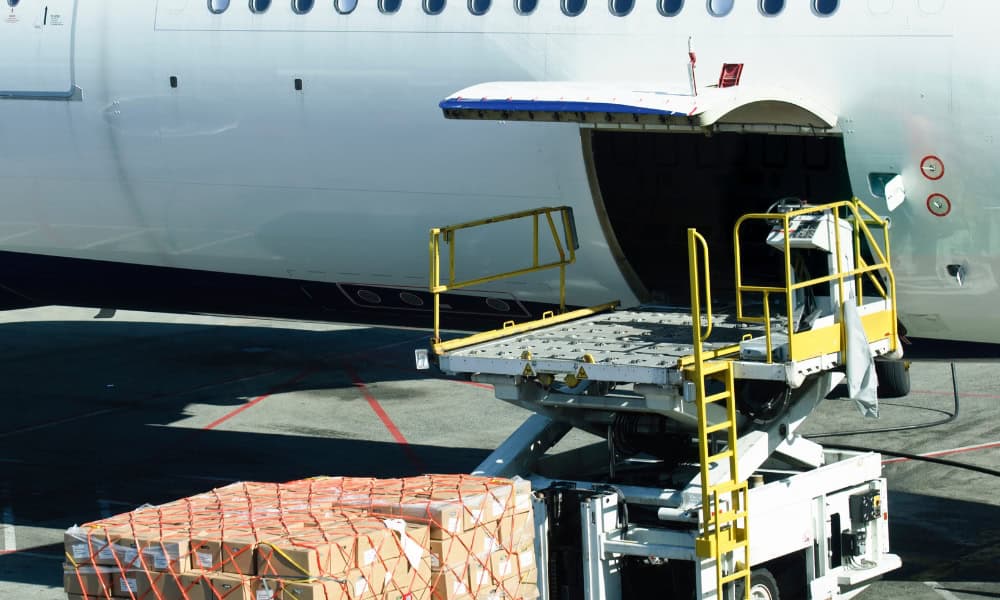
For almost all small international household moves, sea freight groupage is the right answer. Air freight is faster, but the cost difference is substantial and the practical limitations for household goods make it unsuitable except in specific circumstances.
Air Freight vs Sea Freight Groupage for Smaller Household Shipments
| Feature | Air Freight | Sea Freight Groupage |
| Transit time | 3 to 10 days | 3 to 16 weeks (destination dependent) |
| Cost basis | Per kilogram; expensive for household goods | Per cubic metre; cost-effective for household volumes |
| Maximum practical weight | Under 100kg for cost-effectiveness | No practical upper limit |
| Furniture suitability | Impractical for most furniture | Ideal for all household furniture and goods |
| Customs process | HMRC export and destination import | HMRC export and destination import |
| Biosecurity destinations | MPI/DAFF inspection still applies | MPI/DAFF inspection still applies |
| Best for | Urgent documents, laptops, clothing, small valuables | Studio or 1-bed household goods, furniture, boxes |
| Recommended for small household moves | No; except for urgent or very lightweight shipments | Yes; for almost all small household move volumes |
When air freight is justified for a partial overseas shipment:
- The shipment weighs under 50kg and contains no large or fragile items
- The destination requires arrival within two weeks and sea freight cannot meet that timeline
- The items are high-value relative to their weight (electronics, important documents, small valuables)
- The move is temporary and items will be returned to the UK within six months
When sea freight groupage is the right choice:
- The shipment contains any furniture at all, regardless of total volume
- The total volume exceeds 0.5 cubic metres
- The destination is long-haul (North America, Australia, New Zealand, Asia, the Middle East)
- Cost-effectiveness over speed is the priority; this covers the majority of international relocations
Best International Movers for Studio or One-Bedroom Relocations
Not every international removals company handles small moves well. Some have minimum volume thresholds that exclude studio or one-bedroom relocations entirely; others quote without a proper volume assessment and the final cost bears little relation to the original figure.
Knowing what to look for narrows the field considerably.
What to look for in an international mover for a small move:
- Confirmed groupage sea freight service to your specific destination country; not all providers have established consolidation lanes on all routes
- A survey-based quoting process; any provider that quotes without assessing the actual volume is guessing, and the guess is usually wrong
- FIDI or BAR (British Association of Removers) accreditation or equivalent professional membership; these indicate minimum service and insurance standards
- Transparent customs handling; the company should manage export and import customs declarations as part of the service, not pass the responsibility to you
- Marine transit insurance included or offered clearly as an add-on, with terms that cover both professionally packed and owner-packed items explained upfront
- Established track record on your specific destination route; ask about typical consolidation schedules and realistic door-to-door timelines
Questions to ask before booking an overseas move with a small volume:
- Does the quote include door-to-door delivery at the destination or port delivery only?
- Is customs clearance at the destination included in the quote or charged separately?
- What is the minimum chargeable volume and how are partial cubic metres priced?
- How frequently do groupage consolidations sail to the destination?
- What is the full insurance position and what excess applies for owner-packed versus professionally packed goods?
- Is professional packing available for individual items within a small shipment?
Learn about PSS Removals’ experience with small international moves
Shared Container Services for Small International Home Moves
For anyone who has not moved internationally before, the groupage process can feel opaque. Understanding what actually happens between UK collection and delivery at the destination removes a significant amount of uncertainty.
How a shared container service works end-to-end:
Stage 1: Volume assessment and booking
PSS conducts a pre-move survey (in-person or video) to assess the cubic metreage of the shipment accurately. A quote is provided based on the surveyed volume; you pay for the space your shipment occupies. A booking is confirmed with a target sailing date based on the next available consolidation to your destination.
Stage 2: Collection and packing
PSS collects from your UK address on the agreed date. Professional packing is carried out on the day of collection or in advance, depending on the service selected. All items are individually labelled and the packing inventory is completed for customs submission before the shipment leaves the address.
Stage 3: Consolidation at the UK freight depot
Your shipment is received at the PSS freight depot and held securely until the container reaches the required consolidation level for your destination. It is then loaded into the shared container alongside other customers’ shipments, each secured and separated within the container.
Stage 4: Sea freight transit
The consolidated container departs from the UK port on the scheduled sailing. Transit time varies by destination; you receive sailing and estimated arrival dates so you can plan accordingly at the other end.
Stage 5: Destination customs clearance
On arrival at the destination port, the container is cleared by the customs authority. Transfer of Residence documentation (where applicable) is submitted by the local customs agent to claim duty relief. Items subject to biosecurity inspection at Australia, New Zealand and similar destinations are inspected or treated at this stage.
Stage 6: Deconsolidation and delivery
The container is deconsolidated at the destination freight depot. Each individual shipment is separated and delivered to its final address by PSS’s local delivery partner.
Door-to-Door Small Shipment Options for Moving Abroad
For anyone relocating abroad with only a few items, door-to-door service is a necessity rather than a luxury. These customers typically relocate on their own, without a corporate logistics team at the destination to collect from a port warehouse or manage local customs clearance on their behalf.
What door-to-door small shipment service includes:
- Collection from the UK address on a confirmed date
- Professional packing (if selected) or wrapping of items by the collection team on the day
- Transport to the UK freight depot and loading into the consolidated container
- Sea freight or air freight transit to the destination country
- Customs clearance at the destination handled by PSS’s partner customs agent
- Inland delivery from the destination port or depot to the final address
- Placement of items in the agreed rooms at the destination where this is included in the service level selected
Why door-to-door matters specifically for overseas moves with minimal belongings:
Port-to-port services require you to arrange your own customs clearance and onward delivery from the destination port; this is a complex, time-consuming process in a country you are likely unfamiliar with, and the cost of arranging it independently is rarely less than the difference in price between port-to-port and door-to-door. A door-to-door service provides a single point of contact and full accountability for the entire journey; for a small move where you are managing everything yourself, that simplicity has real practical value.
Can I Ship Boxes Internationally Instead of Hiring Movers?
Yes; for very small volumes with no furniture, international box shipping via a specialist provider is a practical and straightforward option.
- International box shipping services allow customers to ship individual boxes, bags or suitcases overseas without engaging a full removal service; the service typically operates on a per-box or per-kilogram basis and includes UK collection and overseas delivery
- Customs clearance is included in most international box shipping services but customers must still complete the required customs documentation; the provider handles the filing
- International box shipping is suitable for personal clothing and effects, books, kitchenware and small non-fragile items that do not require specialist packing
- International box shipping is not suitable for furniture, large fragile items, antiques or anything requiring specialist packing or custom crating; for any furniture at all, groupage sea freight is the appropriate service regardless of how small the furniture volume is
- For moves involving a mix of boxes and a small number of furniture items, groupage sea freight handles both within the same shipment
Explore PSS’s international box shipping and packing supply options
What Is the Most Cost-Effective Way to Move Abroad with Minimal Belongings?
The most cost-effective service depends on your actual volume. Here is a straightforward guide by volume range.
Under ten boxes (no furniture): International box shipping or an international courier service is the most practical option. Self-pack and book directly with a specialist provider. Customs documentation is still required; confirm whether the provider handles this as part of the service or whether you need to complete it yourself.
Ten to twenty boxes or small furniture pieces (up to five cubic metres): Groupage sea freight via a specialist international removals company is the most cost-effective option at this volume. A PSS pre-move survey confirms the actual cubic metreage and the quote is based on that figure. Professionally pack any furniture or fragile items; self-pack clothing and books.
Studio or one-bedroom household (five to fifteen cubic metres): Groupage sea freight remains the most cost-effective option at this volume range, and door-to-door service is strongly recommended to avoid destination logistics complexity. When comparing quotes at this volume, confirm whether customs clearance, door-to-door delivery and marine insurance are all included; these can add significantly to a quote that appears lower at face value.
Larger one-bedroom or small two-bedroom (fifteen to twenty-eight cubic metres): A sole-use 20ft container may become comparable in cost to groupage at the upper end of this range. PSS can provide a direct comparison between groupage and sole-use container costs at the assessed volume so you can make a straightforward financial decision.
Book a free PSS volume assessment and get the right quote for your small move
Minimum Volume Requirements for Small International Moving Services
Many people planning to move abroad with a small shipment assume they will be turned away by removal companies because their volume is too small. This concern is understandable but largely unfounded with the right provider.
- Most international removals companies apply a minimum chargeable volume for groupage sea freight; typically one cubic metre
- PSS accepts small international shipments from one cubic metre upwards; there is no minimum threshold that excludes genuinely small moves
- Volumes below one cubic metre are generally better suited to international box shipping or courier services than groupage sea freight
- Customers with very small volumes (under five boxes) should clarify with PSS whether groupage or box shipping is the more appropriate service before booking; the answer depends on the destination and whether any furniture is involved
- There is no volume that is automatically too small for PSS to assist with; the pre-move assessment determines the right service for the actual shipment
Relocation Packages Tailored to Small Overseas Apartment Moves
Moving abroad with limited belongings is not a reduced version of a large household removal; it is a distinct service requirement that needs its own approach. PSS structures these services around what the customer actually needs, not a scaled-down version of a full household removal package.
What a tailored small move service from PSS covers:
- Pre-move survey (in-person or video) to assess actual volume and confirm the right service type
- Service recommendation based on volume, destination and timeline; groupage, sole-use or box shipping confirmed before any cost is committed
- Professional packing for selected items; customers choose which items PSS packs and which they self-pack
- Customs documentation support; PSS manages export and import documentation and Transfer of Residence applications where applicable
- Marine transit insurance arranged for the declared value of the shipment
- Door-to-door delivery from the UK address to the overseas destination
- Single point of contact; one PSS consultant manages the entire move from survey to delivery
Discover how PSS tailors international moving services to small volume moves
How Long Does a Small International Shipment Take?
Transit times for an international shipment of minimal belongings vary considerably by destination and by service type. The figures below cover total door-to-door time, which is the figure that actually matters for planning purposes. Sea transit time alone is shorter; it does not include consolidation lead time before the container sails or customs clearance on arrival.
Groupage sea freight to Europe (Spain, France, Portugal, Cyprus): Consolidation lead time 1 to 3 weeks; sea transit 3 to 21 days; total door-to-door 3 to 8 weeks.
Groupage sea freight to North America (Canada, USA): Consolidation lead time 2 to 4 weeks; sea transit 10 to 28 days; total door-to-door 6 to 14 weeks.
Groupage sea freight to Australia and New Zealand: Consolidation lead time 2 to 4 weeks; sea transit 4 to 8 weeks; biosecurity clearance 1 to 10 working days; total door-to-door 8 to 16 weeks.
Groupage sea freight to Asia, Middle East and South Africa: Consolidation lead time 2 to 4 weeks; sea transit 3 to 6 weeks; total door-to-door 6 to 12 weeks.
Air freight (all destinations): Transit 3 to 10 days; customs clearance 1 to 5 working days; total door-to-door 5 to 15 days.
The consolidation lead time is the part of the timeline that most surprises people planning their first overseas move with a small volume. It is not sea transit that takes three months to Australia; it is the combined total of consolidation wait, sea transit and biosecurity clearance that produces the full door-to-door figure. Understanding this distinction early helps avoid planning problems at the destination.
Compare Quotes for Small Volume International Household Moves
Comparing quotes for an international shipment with minimal belongings is straightforward once you know what each quote should include. The difficulty is that providers structure quotes differently, and a lower headline figure does not always mean a lower total cost.
What to check when comparing overseas shipping quotes for small volumes:
- Confirm the quote is based on a surveyed volume, not a self-reported estimate; customers consistently underestimate their volume, which means a quote based on their estimate will be revised upward before the move
- Confirm whether customs clearance at the destination is included or charged separately; this is a significant cost if excluded and is not always flagged clearly
- Confirm whether the quote covers door-to-door delivery or port delivery only
- Confirm the insurance position: what is covered, at what declared value and what excess applies for owner-packed versus professionally packed goods
- Confirm the consolidation schedule: how frequently does the provider sail to your destination and what is the next available sailing?
- Confirm whether there is a minimum chargeable volume and how partial cubic metres are priced
Red flags when comparing international shipping quotes:
- Quotes provided without any volume assessment or survey
- Prices that exclude customs clearance without clearly stating this upfront
- No mention of insurance or insurance treated as an optional extra with no clear terms
- Providers unable to confirm the port of destination or realistic transit time to your specific location
Is It Cheaper to Ship Items or Buy New Ones Abroad for a Small Move?
For most categories of personal and household items, shipping is the more cost-effective choice; the hidden costs of buying everything new at the destination are consistently underestimated by people relocating abroad with few belongings for the first time.
- High-value personal items (furniture, electronics, books, clothing) are almost always worth shipping rather than replacing; replacement cost abroad is typically higher than the international shipping cost for these categories
- Sentimental items have no replacement value; ship them regardless of the shipping cost relative to their monetary value
- Low-value consumables (cleaning products, food, basic toiletries) are not worth shipping; buy these at the destination
- Items that are restricted or regulated at the destination may be more practical to purchase locally; certain electrical appliances are a common example due to voltage and plug standard differences
- The hidden cost of buying everything new abroad is routinely underestimated; factor in delivery charges, assembly fees and the disruption of the period without essential items on arrival
- Transfer of Residence customs duty relief on shipped personal effects tips the balance further towards shipping for qualifying moves; used household effects imported under ToR relief are exempt from import duty and local VAT at most destinations
For official Transfer of Residence customs guidance, the UK Government publishes information on moving personal effects abroad at gov.uk. Australia’s Department of Home Affairs covers passenger and crew concessions at homeaffairs.gov.au. New Zealand Customs publishes its guidance for people moving to New Zealand at customs.govt.nz. Canada Border Services Agency sets out settler’s effects provisions at cbsa-asfc.gc.ca.
Small Moves Deserve the Same Expert Attention as Full Household Removals
There is a common assumption that a small international move is a simpler version of a full household removal. It is not. The customs documentation requirements are identical regardless of volume. The biosecurity inspection rules at Australia, New Zealand and Canada apply equally to a single box of wooden items and to a full container. Marine insurance terms, Transfer of Residence eligibility conditions and export declaration requirements do not scale down with the size of the shipment.
The mistakes we see most often on these types of moves are not exotic ones. People choose the wrong service type for their volume; they book air freight for a shipment that would have been far more economical via groupage, or they use an international courier for boxes that contain items the courier’s insurance terms do not properly cover. They underestimate the door-to-door timeline for groupage and arrive at the destination expecting their belongings within two weeks of leaving the UK. And they assume that a small shipment will not attract customs scrutiny; it will, and an incomplete inventory causes the same delays at a small volume as it does at a large one.
Small moves represent a significant proportion of international relocation activity; younger professionals relocating for work, students returning from study abroad, retirees downsizing to an overseas property. PSS approaches every small international move with the same process rigour as a full household removal; pre-move survey, customs support, professional packing options and a single point of contact throughout.
If you are uncertain whether your volume is large enough to warrant a professional service, the answer is to ask. The assessment costs nothing and the answer will be straightforward.
Book a free PSS small move assessment and get an accurate quote today
Frequently Asked Questions
What is the best way to move abroad with only a few items?
For any volume involving furniture, groupage sea freight (shared container) via a specialist international removals company is the best option for a small international move. For very small volumes of boxes or personal effects with no furniture, international box shipping or an international courier service is more practical. The right choice depends on volume, destination and timeline; PSS offers a free assessment to identify the correct service for your specific circumstances.
Can I move overseas without using a full container?
Yes. Groupage (LCL: Less than Container Load) sea freight allows customers to pay only for the cubic metres their shipment occupies within a shared container. A full sole-use container is only necessary for larger household volumes, typically above twenty cubic metres. Most studio and one-bedroom moves are handled via groupage, which is the standard service for small international household shipments.
How long does a small international shipment take?
Groupage sea freight to European destinations typically takes 3 to 8 weeks door-to-door. North America and the Middle East: 6 to 14 weeks. Australia and New Zealand: 8 to 16 weeks including biosecurity clearance. Air freight is faster at 5 to 15 days door-to-door but is significantly more expensive and impractical for furniture. Groupage times include a consolidation lead time before the container sails; this is the part of the timeline that most surprises first-time international movers.
Should I use air freight or sea freight for a small international move?
Sea freight groupage is the recommended option for almost all small international household moves. Air freight is only appropriate for shipments under 50kg, urgent deliveries or high-value lightweight items such as electronics or important documents. For any furniture or standard household goods, air freight costs are prohibitive relative to the value of the items being shipped.
What is the most cost-effective way to move abroad with minimal belongings?
Groupage sea freight is the most cost-effective service for volumes from approximately one to fifteen cubic metres. International box shipping is more practical and cost-effective for volumes under one cubic metre with no furniture. Reducing shipment volume by selling or donating low-value items before the move is the single most direct way to reduce the total cost of relocating abroad with minimal belongings.
Can I ship boxes internationally instead of hiring movers?
Yes, for small volumes with no furniture. International box shipping services collect individual boxes from the UK address and deliver to the destination, including customs clearance in most cases. For any furniture items, a specialist international removals service using groupage sea freight is necessary; international box shipping services are not designed or insured for furniture shipments.
How do I get an accurate quote for a small international move?
Accurate quotes require a proper volume assessment; self-reported estimates are almost always lower than the actual volume. PSS provides free pre-move surveys (in-person or video) to assess actual cubic metreage and recommend the right service. When comparing quotes, always confirm whether customs clearance at the destination, door-to-door delivery and marine transit insurance are all included in the figure you are comparing.
Ready to get started? Use the PSS International Removals Cost Calculator for an initial estimate, or book a free home or video survey to speak with a specialist about your specific volume and destination.